Showing posts with label Edwardian corset. Show all posts

Friday, 5 October 2012

Corset analysis research C2, 4th Oct2012

Yesterday I went to view 4 corsets of the Symington Collection at Leicestershire Museums resource centre.

I had specifically chosen to view the French plunge front corset C2 that I  discussed in a previous post: French Plunge corset 1905. As discussed in my previous post I would like to recreate this corset, but after examining the corset I feel that I may have to modify the original design to accommodate a larger bosom that the original corset would do. I discussed this particular design with the corset expert Sarah Nicol and we both agreed that the design must flatten the bust considerably as there is little shaping in this area. I am now torn between making a modern version using more allowance in the bust or create a straight re-make.

Decisions, decisions.

Besides that particular conundrum, here is some of my research for all you corset buffs should you want to follow my progress...


So, this is the C2. Isn't she beautiful?

Apart from the gorgeous plunge front it has some more notable details such as the unusual busk in which each 'hook' is different from the last. On closer inspection you will notice that the top and middle 'hook' are pointing away from each other whilst the bottom one is fully closed. It has two beautiful frilled elasticated suspenders which are very pretty. 

I love the filigree look to these suspender regulators.
And just look at all that work on the inside!!!

The boning was most concentrated on the front part of the corset, from the side backwards there was only one thick bone per seam but at the front there are at least eight bones that support the front. The other thing that struck me with this corset is how light it is. It is made of only 2 layers, of reasonably light fabrics: cotton satine and cotton twill.


Also of note, in terms of the silhouette, the hip ratio is very generous....which leads me to conclude that this corset was not designed to alter the hipline, but mainly to create a tiny waist and thrust the bust up to the front. This is further supported by the diagonally crossing bones at the side bust which probably attempt to force the breasts foreward away from the underarm.

 The label forms part of the waistband and is present only from the side seam to the back lacing facing.


This corset (above) is made to the same pattern from the same company, but is made from a damask style cream broche. All the boning has been removed from one whole side which makes drafting the pattern easier. Although, it is almost impossible to discern the true pattern piece shapes without taking it all apart and drawing round them it does make my job a little easier.

I'm very much looking forward to giving this corset a crack, promising the wonderful Sarah Nicol that I would send photo's of it actually being worn since a great deal of our conversation concerned the merits, or lack thereof, of the pattern cutting and bone shaping in the front.

I will not know until I make it....that much is for certain.

Sunday, 19 August 2012

French Plunge corset 1905

Today I have finally got a day to think, and draw and paint. It is luxury to have a whole day to think things through.

Today I have been concentrating on things much neglected like research, inspiration and illustration. If the weather holds I'll also do a spot of gardening...

But, to more serious stuff. Today I am going to start on a new and challenging corset. I am going to re-make (or as close as I can approximate from photo's, my notes and my intuition) the C2 corset from the Symington collection. This corset is on almost permanent display so I have not had a chance to study it in hand so I am hoping my guesswork will surfice.

This the best picture of it I have found: 

The C2 is a museum reference number. It was designed and made in France around 1905 and has an atypical plunge front. It is made from black sateen, has a white cotton lining, a waist stay, inner bone casings and pushed the body into the fashionable s-bend shape required of the early Edwardian period.

So...my first step was to check over my notes and gain information about it's construction and put that into illustration:


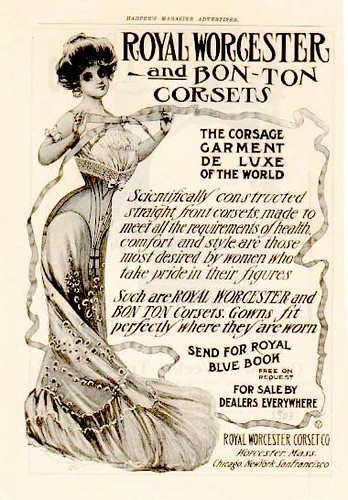
Since the corset can only be viewed from the front I am going to hvae to guess at the back stylines by comparison with it's contemporaries. I am going to use this advert as a reference because I can compare front and back.

Well, that's it for now...better get started.

Wednesday, 11 April 2012

New corset designs

Yesterday I played around with godets...yeah how exciting am I?

In my newest collection I am experimenting with inserts and godets as a way of increasing volume in the area's that need it the most, ie: bust and bums. My collection has been greatly influenced by Edwardiam corsets and the curved seaming techniques that they employed.

Since I'm still pretty much sewing my little socks off day and night I will write no further and just post up an image:


Thursday, 12 January 2012

Consolidation

Now I have this major problem: I am aware of it...but only sometimes do it manage to regulate it. That I work on so many different projects that in a cursory glance it is hard to discern progress.

But today I feel progress is a force in my life:

I have now boned the Edwardian corset I have designed and made for AFW catwalk show it is my sincere desire to finish that corset before bedtime.

To get the bone casings down I ended up doing far more process than I had anticipated. In this style of corset it would be made out of only one layer of fabric and bone casings in the same colour could be sewn through from the back.  However, this corset is made from three layers:the top layer being very thin and likely to drag on the machine teeth if I sew from the back. So first they had to be basted in through all layers and sewn from the front, it was a bit troublesome, some of it still needs tweaking but yielded great results from the top layer.

I'm still in two minds about if and how to decorate this corset...as my indecision as to whether this is a showpiece or will become part of the collection.

Tuesday, 10 January 2012

On track with corset collection

Been a weird day today. Had a great morning finishing off client commission, but the afternoon was just weird. I don't know if this happens to all creative people but I just couldn't get it going in the afternoon. I'm usually sifting through all the head musings to get to the good stuff but today was like my brain was in a vacuum. Until that is when my hubby, who knows I get very cross in this frame of mind, offers me the biggest tankard of coffee and a mars bar, what a star.

Nothing fuels my soul more than coffee and chocolate!

So I decided 2 things: to get my Edwardian corset on the move again and finally finish the first corset of the new collection rather than moving onto the next three designs and to design my next TG costume which is to be based on the 1911 corset from my previous blogging. Yay!

Edwardian corset now:
Marvelous. All I have left to do is boning, flossing, binding and decoration...oh and some suspenders. Ultra sexy.

Friday, 6 January 2012

Beauty and strength: construction notes

So today is all about getting on with my Edwardian style corset in peach satin and black lace...

The busk is in, that's the metal hook and stud closure at the front of a corset, and the boning is in the back. There is a special bow detail I want to put in the waist so I have just basted the rest of the corset together to give an idea of the final shapes.

Edwardian corsets are my favourite of all the corset styles, and they are also the most extreme and highly engineered. Most of my newest designs are based on Edwardian features. This is a typical advertisement of the time:
As you can see the features of this period are a prominant bosom and bum, tiny waist and a tipped forward stance, more commonly defined as the S-bend. Seamlines are diagonal, curved and complex, whilst boning was positioned mostly vertical. I don't plan on staying entirely historically accurate because my intention is to make a wearable corset that won't cripple my customers whilst still bearing the design features that I like the most about this period of corsets.

So, to recap my progress with this corset:


I have previously made a corset, based on Edwardian features to test construction and pattern fit: It doesn't fit on the tailors dummy entirely correctly because a dummy is not soft and pliable like a real body.

From this successful design I have changed my pattern to the new design and begun construction. This peach broche corset is a single layer corset, similar to Edwardian ones, and is strong enough on it's own to withstand much wear...but the materials I am making the new corset out of are not, so I am having to build a seperate outer and inner layer...which is problematic just from the point of view of matching up all 40odd seams but also that the seams cannot become bulky even though they have 6 layers of fabric in them.

This is fabric engineering!

So this is where I am now at:

It is coming along very nicely, just have to wait for my delivery of black silk so I can finish it off, yippee!

If any of you are thinking of trying to make this style it is definatly one of the most rewarding things to do and I have a few tips to make your life a bit easier that I found out as I was going along. I'll be doing a propper construction blog on this style of corset when I have a bit more time to properly devote it, but anyway in the mean time my quick advice tips are:

  • double stitch all seams
  • reinforce potential weak points
  • use the correct boning
  • build in a waist stay

Tired musings...

Today I started work at 7pm. I wish I could spend all day making pretty things but unfortunately it was one of those days when you just have to go and sort stuff out!

I put my french knicker block together, as I really wanted to test the pattern and I have come to the conclusion that I do not really like classic french knickers. They may be flattering on some 6foot lithe model but on my chubby thighs I look like I should be kicking around on a football field! I really wanted to go for a vintage underwear look but to be honest I think modern knicker types are just way more sexy and flattering.

Back to the drawing board...literally.

Aside from that I have been carrying on with my Edwardian style long line corset in peach and black lace. I have put in the lining and will do the busk and boning channels when there is plenty of day light and my eyes don't hurt so much. It's going really well and I've got some fantastic idea's for details. I'm so excited I just want it done so I can sit back and marvel.

Also been playing with some guipure lace and raspberry silk dupion on the mannequin to get the next corset forming in my mind., More on that after a sleep.

Boy I'm tired, goodnight.X

Tuesday, 27 December 2011

Titanic era corsets

Today I've been thinking about Titanic or teens era corsets as it is also known. I personally think of this era as a transition period between the true S-bend corset of the early Edwardian period and the advent of the fall of grace of corsets in the fashionable wardrobe in the 1920's.

The development of this corset style is directly influenced by a huge shift in female fashion from the body altering wasp waist to a more streamlined silhouette...but remained restricted by a modern woman's standards. This was in part to the steady lengthening of the corset over the hipline assisted by a new invention, elastic, which now meant that stockings could provide the pulling power necessary to keep the corset taught under the sleek new fashionable style.

This is Camille Clifford ( 1885-1971), who was a famous tight -lacer. She exemplifies the silhouette of this time: both bust and bum are proud, contorting the body into the infamous S-bend which renders the waist stretched between the bust and bum extremes. It must have been an uncomfortable pose indeed, although considering that women were so used to wearing corsets in those days perhaps not as much as us modern women would think?


Major design features of this period:


  • extreme long line corsets
  • mainly vertical seaming and boning channels
  • streamlining of hips
  • straight 'neckline' cutting either mid or below the bust
  • usually accompanied by suspenders
  • neutral colours
  • little or no hand finishing
  • internal boning channels

Tuesday, 23 August 2011

Inspiration abound...

Well, it's nearly the end of my maternity leave and I am very excited about starting work again.

I feel so inspired by my last trip to research the Symington collection last Saturday that my mind has been buzzing with new idea's. Laid out for us was about 60 corsets of varying design and era, and after an informative talk by Phillip Warren on the history of the Symington company and how the collection came to be, we were allowed to take pictures and make notes.

I was most interested in the complex seaming and longline cut of the Edwardian corsets, as this is most relevant to my next collection. Although I managed to get round all of the corsets and take reference shots of all the things I found interesing, I picked out 4 corsets for special attention to really get my head around the construction techniques particular to that era.
It's all about exaggerating the most obvious of female assets...glorious big hips, a tiny waist and a full bustline! The development of the longer line corsets of this era were a reaction to a changing silhouette in which skirts fit snuggly over the hips and the development of elasticated suspenders which had the effect of keeping the long corset wrinkle free over the hip by the tension of pulling up the hose.

Anyway, it has sparked a renewed interest in getting really into the pattern cutting of corsets, and paying attention to those extra special details that make it unique in the world of fashion.

On my long train ride to get there, between bouts of sleep, I really thought hard about what it is about corsets that I find so interesting and I came to the conclusion that what excites me is the role of the corset to physically change and conform the body to it's shape, to exert force to intimatly and modify the nature of the wearer directly. Unlike other garments which externally alter the silhouette through disguise.

But more news on my next collection later, as it's still very much early stages in the process, but I will say that my mum is knitting furiously to give me some rather interesting accessories.

Friday, 1 July 2011

Corsets - the beauty of fan lacing

The fan lacing corset was designed with only one idea in mind : to make the corset easier to lace up ones-self.
There are two notable companies that were at the top of their game in this specific corset design genre: Jenyns and Camp.
When I did research at the Symington Collection I got to see oa Jenyns corset up close, and I kid you not....it was a fantastic feat of engineering!

The things that defines this type of corset is the lacing at the back and how the criss crossing of the lacing between the fan and the corset provides the ingenious ability if the wearer to be in complete and sole control of tightening the lacing without the need for assistance.

This particular corset is made under license by the Symington Company, and is dated 1911. Here is the original advertisment:
The corset sat low under the bust, and provides no support there, and low over the hip - giving supposed excellent suport of the lower back. This model was popular well into the WW1 era when women donned their Jenyns to support their backs as they worked in factories for the war effort.
The corset is made of white coutil.

This is an exert from my sketchbook about this specific model.


The brand 'Camp' was the main rival to the Jenyns and was invented by Samuel Higby Camp in 1908, but not patented until 1921. Whilst the original Jenyns models used lacing sewn into the fan shape Camps featured a metal fitting that allowed the lacing to remain in one length and allows the lacing to be adjusted using a pulley system rather than simply by front buckles as in the above Jenyns example. Later jenyns examples feature Camp's pulley concept.
In trying to understand the way this works I have mocked up a simple short version of a Jenyns corset. Unfortunatly at the time of experiment I didn't have any of the little metal pulleys, so have replaced it with eyelets. At this stage I have omitted the belt tightening because it clashes with the eyelet system. I have used two different coloured laces to show the crossing pattern...it's the geek in me.
 Since then I have now sourced the metal bits I need to create a true fan lacing corset I'm off to do some mor experimenting...
Related Posts Plugin for WordPress, Blogger...